From Alignment to Contribution: Mirova’s climate approach is evolving
Since its creation nearly fifteen years ago, Mirova has developed tools to assess the consistency of investments with long-term climate objectives. This work has helped to advance more comprehensive alignment approaches, notably incorporating indirect emissions, companies’ transition plans and the contribution of climate solutions.
Today, against a backdrop in which global climate trajectories remain far from the goals of the Paris Agreement, an additional question must be addressed: how can investors demonstrate that investment is genuinely helping to accelerate the transition of the real economy? Recent industry initiatives, notably the Net Zero Investment Framework (NZIF) 2.0, encourage investors to complement alignment measurement with a more explicit analysis of their levers for action and influence.
This is the rationale behind the evolution of Mirova’s climate approach: a continuation of our longstanding work, designed to provide a clearer account of the effective contribution made by investment strategies to the transition towards a low-carbon economy.

An evolution consistent with our climate approach
Over the past decade, the integration of climate considerations into asset management has become considerably more structured. Initially, efforts focused on developing measurement tools to assess portfolios’ carbon footprints and their alignment with climate pathways.
Since its earliest work on portfolio climate alignment, Mirova has advocated an approach that goes beyond measuring financed emissions alone. Our objective has always been to assess the capacity of economic and financial actors to contribute to an economy compatible with long-term climate objectives. This led us, at an early stage, to incorporate indirect emissions, avoided emissions associated with climate solutions and the quality of companies’ transition plans into our analyses[1].
These approaches have contributed to significant advances in transparency and management.
In particular, they have improved understanding of:
- portfolios’ emissions profiles;
- their consistency with transition scenarios;
- and exposure to sector-specific climate issues.
However, they also have certain limitations:
- they rely on models and assumptions;
- they often provide an aggregated and static view;
- they do not fully capture the dynamics of companies’ real-world transformation;
- they do not reflect the full range of levers available to investors, particularly engagement.
At a time when expectations from investors, regulators and society are increasing, one question now stands out: what concrete role can investors play in accelerating the transition?
The Net Zero Investment Framework (NZIF), in particular, places greater emphasis on investors’ capacity to mobilise their levers for action: capital allocation, shareholder engagement, the financing of solutions and the quality of reporting.
From alignment to contribution: two complementary approaches
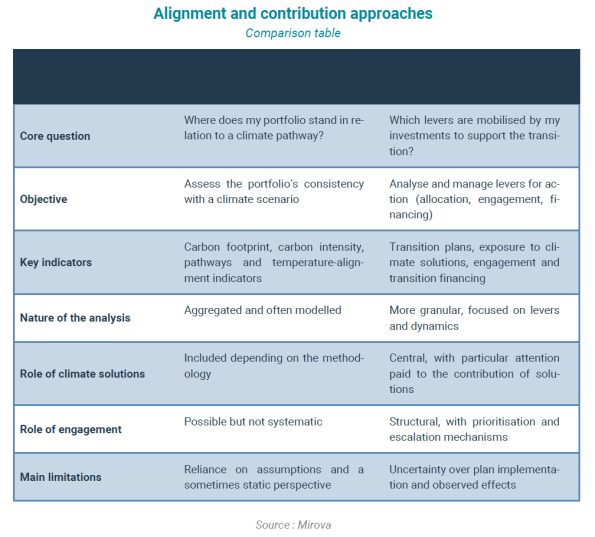
Alignment and contribution approaches share a common foundation while addressing distinct and complementary objectives.
Alignment seeks to assess a portfolio’s consistency with a given climate pathway. It is an essential tool for understanding investments’ exposure to transition issues and assessing the long-term compatibility of the business models financed:
- the consistency of emissions profiles;
- modelled pathways;
- and sector exposure.
Mirova has historically contributed to improving this approach, notably through the development of methodologies incorporating:
- all company emissions, including Scope 3;
- the quality of transition plans;
- the contribution of solutions through avoided emissions, which are generally a significant blind spot in so-called ITR (Implied Temperature Rise) approaches.
Contribution addresses a different question: to what extent can the investor support the decarbonisation of the real economy, and which levers can be mobilised to strengthen that contribution? In other words, alignment primarily assesses a pathway, whereas contribution seeks to understand and reinforce the mechanisms through which investment can accelerate the transition.
The shift towards a contribution approach places greater emphasis on:
- the quality of transition plans;
- climate solutions brought to market;
- financial support for economic transformation;
- as well as shareholder engagement and the collective influence exercised by investors.
A contribution approach seeks to make the levers mobilised and their monitoring more explicit, while distinguishing between assets and strategies. The focus is therefore placed more firmly on the investment strategy in relation to its stated objective, rather than solely on a snapshot of the portfolio.
A more comprehensive and operational view of portfolios
For investors, the shift towards a contribution approach provides a more comprehensive view of portfolios.
Historical carbon-footprint indicators remain fully in use and are complemented by new dimensions that provide a better understanding of:
- exposure to climate solutions and their positive impact;
- the maturity of climate transition plans;
- the increasing scale and effectiveness monitoring of engagement initiatives.
The objective is not to produce a single indicator, but to provide a multidimensional view of climate issues in order to better understand:
- what is actually invested in;
- how companies evolve over time;
- which levers for action can be mobilised to support that evolution.
This evolution is gradually being accompanied by adjustments to reporting in order to preserve the clarity and comparability of the information made available to investors.
SHAREHOLDER ENGAGEMENT: A CORE LEVER OF OUR CONTRIBUTION APPROACH
Mirova regards shareholder engagement as an essential lever for supporting companies’ transformation. The contribution approach does not alter this conviction; it allows climate analysis and the engagement strategy to be more closely aligned.
Analysing the maturity of transition plans, combined with identifying the sectors facing the most significant climate issues, makes it possible to target more effectively the situations in which shareholder dialogue is likely to support real changes in practices, governance or investment decisions.
This approach also leads to more precise expectations being set for companies. The objective is not only to assess a pathway, but also to encourage the adoption of credible transition plans that are consistent with sector-specific characteristics and the economy’s decarbonisation needs.
The NZIF strengthens this approach by providing tools that help prioritise engagement actions, monitor progress and, where necessary, progressively activate different levers of influence, from dialogue and voting to collaborative initiatives.
Lastly, a contribution-based approach strengthens transparency requirements. Without claiming to attribute observed developments directly to the actions of a particular investor, it provides a clearer account of the initiatives undertaken, the objectives pursued and the progress observed over time.
An approach built around three interconnected levers
Supporting emissions reductions
The objective is to direct capital towards the companies best prepared for the transition and, through engagement, to support those whose transition plans still need to be strengthened. Systematic analysis of the maturity of transition plans is a core component of this approach.
Supporting the development of climate solutions
The transition cannot be achieved without the large-scale deployment of technologies, products and services that reduce emissions across the economy. Mirova seeks to identify, measure and finance these solutions across its different asset classes.
Directly financing projects with a positive carbon impact
In certain asset classes, particularly natural capital, investment can directly finance projects that avoid or sequester emissions. These investments represent a complementary lever for contributing to carbon neutrality.
The main implementation priorities for our contribution approach
Better measurement of transition dynamics
Our analysis covers all emissions, including Scope 3 where relevant, as well as transition dynamics and the contribution of climate solutions. It draws in particular on more than a decade of methodological work and on the Climate Contribution Framework developed with several partners.
Directing capital towards the strongest contributors
Climate analysis seeks to identify the companies, projects and solutions most likely to contribute to the transition, taking account of the specific challenges facing each sector. For listed assets, this approach draws in particular on analysis of the maturity of transition plans.
Supporting transitions
Investment is not limited to capital allocation. It also involves ongoing dialogue with companies to encourage the adoption of practices, objectives and transition plans consistent with climate-related challenges. This approach is pursued through individual dialogue, collaborative initiatives and industry-wide work.
Strengthening transparency
Lastly, we are evolving our reporting to distinguish more clearly between the climate performance of financed assets and the levers mobilised by the investment strategies themselves. The objective is to provide a more comprehensive view of the mechanisms that may contribute to the transition.
Naturally, this approach must take account of the specific characteristics of each asset class, particularly the climate materiality of the economic sectors concerned, data accessibility and the levers of influence available to the investor.
Alignment approaches have made a major contribution to structuring climate finance over the past decade. Today, investors are also seeking to better understand how their allocation decisions and engagement actions can support the transition of the real economy.
The evolution of Mirova’s climate approach is part of this continuum: maintaining the methodological rigour that characterises our work while strengthening our ability to report on the contribution levers mobilised in support of the transition.