Trending Forward: Navigating Economic Uncertainty
The rise of the value-conscious consumer
Investing Insights from the Sustainable Equity Team

In brief
- Economic challenges are driving consumers across income levels to prioritize value-driven purchases.
- While consumer spending has remained resilient, spending is increasingly concentrated among affluent populations.
- Off-price retailers are well positioned to benefit from the growing trend of value-conscious consumer behavior.
Demographics
Generational Shifts
Investing in Megatrends
We invest in companies with meaningful exposure to economic tailwinds from longterm transitions that are affecting the global economy: demographics, environmental, technological, and governance. The demographics transition includes rising middle class in emerging markets, aging populations, increasing urbanization and shifting lifestyles, all of which are expected to impact healthcare, consumer products, and financials, among others, in the coming decades.
As consumers navigate an increasingly uncertain economic environment, a clear trend has emerged: an increased focus on value. This shift in consumer behavior is largely driven by economic factors, including inflationary pressures, diminishing purchasing power, and geopolitical uncertainty. We are witnessing a widening divide between higher- and lower-income consumers, or a K-shaped economy. Lower-income consumers are struggling with rising costs and the effects of tariffs, while higher-income consumers are benefitting from a strong wealth effect. Despite the growing income disparity, both groups are aligned in their search for value in their purchases, reflecting a shared response to the challenges of an uncertain economic environment
The top 40% of households by income account for 60% of all consumer spending those households also control nearly 85% of America's wealth1.
Consumer spending, which drives 2/3 of us economic activity, is more concentrated among the wealthiest 10% of americans than ever before2.
The market is currently navigating a complex landscape where economic growth persists alongside consumer uncertainty. Consumer spending in the US has remained resilient for the past few years, although it is highly concentrated among higherincome households. Affluent populations are supporting consumption while other segments of the economy continue to struggle.
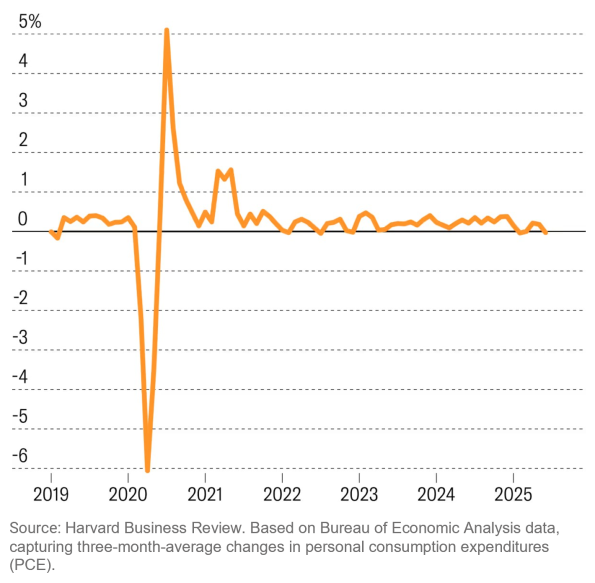
Due to economic factors, the consumer is increasingly seeking the best value for their money. We anticipate this shift to value to persist alongside economic uncertainty. Companies that can address this shift and align with consumers’ priorities will be well positioned to capture a larger market share. TJX, an offprice retailer, is successfully capturing the value-conscience consumer.
70% of consumers plan to continue shopping from off-price retailers in the next 12 months, even if they have more money to spend3.
Portfolio Company Example
TJX is uniquely positioned to capture a range of consumers, targeting both lower- and higher-income shoppers who are increasingly prioritizing value. By offering products at substantial discounts, typically ranging from 40% to 70% off traditional retail prices, TJX significantly enhances its appeal, especially during a challenging economic environment4 . By delivering exceptional value, TJX can attract the cost-conscious consumers, strengthening its competitive advantage in the retail landscape.
TJX Investment Considerations
Leading Position in Off-Price Retail: As the #1 player in the attractive off-price retail sector, TJX is well positioned to grow its market share and enhance profitability over the long term.
Flexible Business Model: The company’s highly adaptable retail model is supported by world-class buying capabilities and a global supply chain and distribution network specifically designed for off-price retail.
Solid Financial Profile: TJX maintains a strong balance sheet with stable sales growth and margin expansion.
High-Quality, Defensive Business: This is a high-quality company with a defensive business model, making it well suited to navigate economic uncertainty.
Experienced Management Team: TJX benefits from strong leadership with decades of proven execution.
TJX can benefit from both trade-down behavior in a contracting economy and tradeup trends during periods of expansion. Unlike most retailers, TJX thrives in challenging economic environments, particularly when excess inventory is prevalent. By prioritizing quality products and the in-store experience, TJX further differentiates itself from competitors. Their world-class buying organization allows the company access to high-quality, branded merchandise at significant discounts, reinforcing its value proposition. Approximately 80% of TJX’s revenue is generated in the US with the remaining sales coming from primarily Canada and Europe. TJX strategically enters markets only when it sees a viable off-price value opportunity. For example, in Spain, where consumers are particularly brand- and fashion-conscious, TJX has successfully sourced products that appeal to this demographic and will open its first store in Spain in Spring 2026. While TJX is not positioned for high growth compared to other themes like AI, it plays an important role in investment portfolios by providing a steady and more defensive growth profile. TJX's business model is designed to benefit from a variety of economic conditions, making it a resilient option for investors.
Risk Management & Responsible Practices:
As the leading off-price apparel and home fashions retailer, TJX’s business model facilitates the diversion of products that would otherwise be considered waste. Globally, it is estimated that every year 30% of clothes produced are never sold and directly end up in landfill5. Although TJX offers a diverse range of products that may not be inherently sustainable, we believe the company is actively providing solutions that align with the principles of the circular economy and the waste hierarchy (Reduce, Reuse, Recover). By giving many products a second chance to be sold at a discount, TJX offers a preferable alternative to products being discarded. However, the overproduction of goods remains a fundamental issue that requires better practices among manufacturers to limit excess inventory within the retail sector. Regarding company practices, TJX operates within the US retail industry which inherently leads to more risks in terms of human capital management. Some challenges include fast-paced work environments, unstable schedules, risks of physical injuries and mental health issues, and relying on temporary workers. To address these risks, TJX is committed to freedom of association and has implemented measures to ensure equal opportunities for employees. However, there is an opportunity for TJX to improve the level of transparency on key Human Capital Management indicators which would further strengthen their commitment to responsible practices.


Cindy HUANG
Equity Analyst
1Source: Morgan Stanley. (2025). Understanding the 'K-Shaped' Economy: Investor Guide 2025.
2Bloomberg. (2025). How the K-Shaped Economy is Hurting Everyone but the Rich. The information provided reflects MIROVA’s opinion as of the date of this document and is subject to change without notice. The reported data reflect the situation as of the date of this document and are subject to change without notice. CFA® & Chartered Financial Analyst® are registered trademarks owned by the CFA Institute. The securities mentioned above are shown for illustrative purpose only and should not be considered as a recommendation or a solicitation to buy or sell.
3Source: McKinsey & Company. The State of Fashion 2025. McKinsey & Company. (2025).
4Source: Mirova Research. The securities mentioned above are shown for illustrative purpose only and should not be considered as a recommendation or a solicitation to buy or sell. The information provided reflects MIROVA’s opinion as of the date of this document and is subject to change without notice. The reported data reflect the situation as of the date of this document and are subject to change without notice.
5Source: European Parliament. (2022). Corporate sustainability reporting: Current situation and future prospects. The securities mentioned above are shown for illustrative purpose only and should not be considered as a recommendation or a solicitation to buy or sell. The information provided reflects MIROVA’s opinion as of the date of this document and is subject to change without notice. The reported data reflect the situation as of the date of this document and are subject to change without notice.

The shift from experimentation to predictive discoveryInvesting Insights from the Sustainable Equity Team

Climate, Nature and Sustainability Report (LEC 29, TCFD, TNFD)

A strategic component of long-term economic growthInvesting Insights from the Sustainable Equity Team